

Cold Storage Insulation Board
Changzhou Jiangyou Heating&Cooling Technology Co., Ltd.: Your Professional Cold Storage Insulation Board Manufacturer!
We are located at No. 14 Fengrun Road, Luoyang Town, Wujin District, Changzhou City, Jiangsu Province, and are a comprehensive enterprise integrating technology research and development, production, sales, and service. Our company adheres to the principles of seeking truth, being pragmatic, innovating, and actively absorbing advanced technologies from domestic and foreign peers to continuously improve product quality and meet different customer needs. Our products have covered all provinces, municipalities, autonomous regions, and centrally-administered cities in China. With reliable product quality and excellent pre-sales and after-sales services, we have won the favor and trust of our customers.
Advanced Technology Equipment
Our company has introduced advanced technologies and equipment from both domestic and international sources, committed to producing high-quality refrigeration and air conditioning equipment. Through continuous innovation and technological upgrades, we can provide our customers with efficient, environmentally friendly, and durable products.
Diverse Product Lines
Specializing in the production of various high-demand cold storage plates, including arc angle cold storage plates, we offer products featuring environmental protection, corrosion resistance, and high flame retardancy. Additionally, we manufacture a wide range of cold storage doors such as double-open, single-open, electric or manual translational doors, chain doors, automatic return doors, free anti-collision insulation doors, modified atmosphere doors, and clean doors to meet diverse customer needs.
Professional Technical Services
Our business scope includes technical services, development, consultation, exchange, transfer, and promotion. With a professional technical team, we provide one-stop services from product design to installation and commissioning, ensuring every project achieves optimal results.
Comprehensive After-Sales Service
Beyond manufacturing and selling high-quality refrigeration and air conditioning equipment, we also offer installation and maintenance services. We commit to providing full support and assistance at every stage before, during, and after the sale, ensuring our customers face no worries throughout their usage period.
-
![100mm Cold Storage Insulation Board]() 100mm Cold Storage Insulation BoardDesigned for optimal energy efficiency in cold storage facilities, our 100mm insulation board features a dense, high-performance foam core that effectively resists heat transfer.read more
100mm Cold Storage Insulation BoardDesigned for optimal energy efficiency in cold storage facilities, our 100mm insulation board features a dense, high-performance foam core that effectively resists heat transfer.read more -
![150mm Cold Storage Insulation Board]() 150mm Cold Storage Insulation BoardFor larger-scale cold storage applications requiring superior insulation performance, our 150mm insulation board is the ideal solution.read more
150mm Cold Storage Insulation BoardFor larger-scale cold storage applications requiring superior insulation performance, our 150mm insulation board is the ideal solution.read more -
![200mm Cold Storage Insulation Board]() 200mm Cold Storage Insulation BoardWhen maximum insulation is paramount, our 200mm cold storage insulation board is the ultimate choice. Boasting an impressive thickness of high-density polyurethane foam, it creates an impenetrable...read more
200mm Cold Storage Insulation BoardWhen maximum insulation is paramount, our 200mm cold storage insulation board is the ultimate choice. Boasting an impressive thickness of high-density polyurethane foam, it creates an impenetrable...read more -
![304 Stainless Steel Cold Storage Insulation Board]() 304 Stainless Steel Cold Storage Insulation BoardCombining the corrosion resistance of 304 stainless steel with advanced insulation technology, our cold storage insulation board is tailored for demanding hygiene and sanitation requirements.read more
304 Stainless Steel Cold Storage Insulation BoardCombining the corrosion resistance of 304 stainless steel with advanced insulation technology, our cold storage insulation board is tailored for demanding hygiene and sanitation requirements.read more -
![PU Cold Storage Hook Plate]() PU Cold Storage Hook PlateInnovatively designed for versatile storage needs in cold environments, our PU cold storage hook plate integrates both insulation and organizational functionality. Crafted from high-quality...read more
PU Cold Storage Hook PlateInnovatively designed for versatile storage needs in cold environments, our PU cold storage hook plate integrates both insulation and organizational functionality. Crafted from high-quality...read more -
![Polyurethane Light Sheet]() Polyurethane Light SheetDesigned for energy-efficient lighting solutions in cold storage facilities, our Polyurethane Light Sheet combines advanced illumination technology with exceptional insulation properties. The...read more
Polyurethane Light SheetDesigned for energy-efficient lighting solutions in cold storage facilities, our Polyurethane Light Sheet combines advanced illumination technology with exceptional insulation properties. The...read more


What is a Cold Storage Insulation Board
Cold storage insulated boards are specialized insulated metal panels (IMPs) designed for the construction of refrigerated storage facilities. These panels, often referred to as cold room panels or cold storage panels, are essential components in creating controlled temperature environments for the storage of perishable goods. The goal of the insulated panels is to ensure a proper temperature is maintained inside the cold panels, and that air leakage is prevented to ensure maximum safety. Generally, insulated panels are used in the external and internal roofs in different outlets, warehouses, factories, airports, and various buildings.
Advantages of Cold Storage Insulation Boards
Excellent thermal insulation
Cold storage insulation boards are made of high-quality thermal insulation materials such as polyurethane or polystyrene, which have excellent heat resistance. This insulation helps prevent heat transfer, keeping the interior of the refrigerated facility at the desired temperature. As a result, products stored within the facility are protected from temperature fluctuations, ensuring their quality and safety.
Energy efficiency
The superior insulation provided by cold room panels helps improve energy efficiency. By minimizing heat transfer, these panels reduce the workload on the cooling system, thereby reducing energy consumption and operating costs. This makes cold room panels a sustainable and cost-effective solution for temperature-controlled environments.
Customizable design
Cold storage insulation boards are available in a variety of sizes and thicknesses, allowing customization to meet specific requirements. Whether it is a small cold storage facility or a large industrial warehouse, these panels can be customized to suit the dimensions of the space, ensuring a seamless and efficient installation process.
Quick installation
Unlike traditional construction methods, cold room panels can be quickly assembled on-site, reducing downtime and allowing rapid commissioning of temperature control facilities. This quick installation not only saves time but also minimizes disruption to ongoing operations, making it ideal for time-sensitive businesses.
Hygienic and easy to clean
Cold room panels are designed to meet strict hygiene standards, making them suitable for applications in the food and pharmaceutical industries. The smooth, non-porous surface of these panels is easy to clean and maintain, ensuring a hygienic environment for storing sensitive products.
Durability and longevity
Cold room panels are engineered to withstand harsh environmental conditions and heavy use. Its sturdy construction and corrosion resistance make it a durable solution for long-term use, providing reliable infrastructure for temperature-controlled storage facilities. In summary, cold room panels offer a variety of advantages for creating and maintaining a temperature-controlled environment. From superior insulation and energy efficiency to customizable design and quick installation, these panels play a vital role in ensuring the integrity of products stored in cold storage facilities. With their hygienic properties and durability, cold room panels are a valuable investment for businesses seeking to maintain the quality and safety of temperature-sensitive goods.
Types of Cold Storage Insulation Board
Expanded Polystyrene Insulated Panels
Expanded polystyrene insulated panels are suitable for people and businesses who want to enjoy maximum insulation in cold rooms with the lowest budget. The R-value of such panels is about R-3 to R-4 per inch. Generally, a higher value of R means better thermal performance. This is considered to be one of the most reliable and efficient PU panels for cold rooms.
Neopor Insulated Panels
The best way to understand the Neopor insulated panels is to consider them as an improved version of the EPS. It is created with the same process but after adding graphite. It has an R-value of 4.5 per inch, which is significantly higher than the value of EPS. Moreover, the NEO panels are much less permeable reducing the amount of air and water going through the panel, providing maximum comfort and efficiency.


Compressed Straw Cole Insulated Panels
Straw IPs are quickly becoming popular among people because they are much more eco-friendly than the rest of the types of panels. Renewable waste agricultural straw is used in such panels. However, you should keep in mind that they have a low R-value and are significantly heavier than the other panels.
PU Panels
There are many benefits of installing PU panels for cold rooms. A massive amount of energy is saved by installing the right kind of panels. Panels also facilitate diverse applications for both internal and external walls, providing the much-needed thermal efficiency in cold rooms. Professional PU panel suppliers can construct the panels and the cold rooms in the best way possible. As a result, the time of construction is reduced, and the best practices are used to get the maximum benefits from the panels.
Three Tips for Cold Storage Insulation Board Installation
Wall panel installation
(1)The installation of the wall panel should be started from the corner. By the plate-laying diagram, two boards need to be installed at the corners of the installation site, according to the height of the board beam and the type of angle iron fixed mushroom head nylon bolts, drill a hole in the middle of the board width at the corresponding elevation position, drilling should be perpendicular to the board surface, the hole on the mushroom head nylon bolts (nylon bolt body and mushroom head should be sealed with sealing paste), set on the angle iron tightening, tighten the degree of the nylon bolts to make the surface of the board A slight depression is appropriate. When standing wallboard, should be in contact with the floor groove of the board padded with foam and other soft materials to prevent damage to the board, two corner wall boards from the board floor groove in time after the neutral, should be adjusted according to the placement position of the wallboard plane position and the verticality of the board, and check the top elevation of the wallboard is correct (straight from the beginning to the end need to check). After the correct position of the wall plate, the angle iron pieces will be welded on the plate beam, fixed inside and outside the package corner (package corner plate on both sides of the inside with the library board contact to play a sealing paste). In the welding angle iron pieces, should be covered with a shield at the corner iron pieces of the warehouse plate, to prevent arc welding when the high temperature of welding burns the warehouse plate and welding slag splashes to the warehouse plate.
(2)After the installation of two wall panels at the corner, start to install the next wall panel along the corner. The next wall plate should be installed before the ground will be a convex groove or groove of the board to play two white sealing paste (sealing paste should be played in the corner of the convex groove or groove of the board), playing in the convex groove or groove inland sealing paste should be a certain height, should also be dense and continuous uniform, the installation method is the same as the first wall plate.
(3)Between the two library boards first with a hammer to hit the pad in the polyurethane library board on the place wood, so that the board and the board close together. Two sets of connectors are wedged between the wall plate and the wall plate, and the two sets of connectors are fixed on the outside and the inside of the wall plate and the wall plate gap, and the connectors on the inside of the wall plate should be as far down as possible so that the concrete can cover the connectors after pouring. The gap between the board and the board should be kept at about 3mm wide after wedging with the connectors, if it does not meet the nuclear requirements, the board will be removed, the board edge will be repaired, and then the board gap will be reinstalled to meet the requirements. When fixing the connector, we should pay attention to the two parts of a set of connectors are fixed in the edge of the convex and concave two plates, fixed with φ5X13 rivets, the distance of the connector to be able to pull the two plates tightly as appropriate. When wedge tightening wedge iron, hammer and wedge iron to maintain vertical, avoid touching the board, the upper and lower parts of the wedge iron should be wedged tightly at the same time, fixed with rivets wedge iron.
The installation of the top plate
(1)Before installing the top plate, the ceiling should be installed with T-iron according to the drawing. When installing the T-iron, the T-iron should be properly arched according to the span of the rigid frame to ensure that the T-iron does not produce downward deflection after the installation of the top plate. The installation of the top plate should start from the corner of the warehouse body, and according to the plate-laying diagram, the warehouse plate should be raised to the specified height and position, and the longitudinal plate end of the warehouse plate should be placed on the wall plate and T-iron respectively. Adjust the parallelism and verticality of the coaxial line of the top board, review the elevation of the bottom surface of the top board, then fix the top board with T-iron with pull rivets, connect the top board with the corner board between the wall board, and then start the installation of the next board.
(2)The second top plate installation method is basically the same as the first plate, board board connection method is basically the same as the installation of the wall plate. The connection should be fixed outside the warehouse, each warehouse board slit should be fixed three warehouse board connections, one at each end of the warehouse board and one in the board (the length of the top board is less than 4 meters, two warehouse board connections are also available).
(3)After the installation of all the top plates, start the installation of ceiling C-beam. According to the actual row of the top plate, on the ground will be fixed mushroom head nylon bolts angle iron pieces according to the corresponding spacing welded in the ceiling C-shaped steel. Then put the ceiling C-beam in the corresponding position of the top plate according to the drawing, and the ceiling C-beam should ensure the parallelism and verticality of the coaxial line. After adjusting the position of the ceiling C-beam, open the hole of the top plate in the position of the bolt hole of the angle iron piece, and connect the angle iron piece with the warehouse plate firmly with the mushroom head nylon bolt. After that, weld the ceiling C-beam to the purlin with the round steel pendant, and adjust the nut under the round steel pendant to adjust the ceiling C-beam and the top plate to the specified height according to the elevation of the bottom of the top plate.
The installation of the corner board
All cold storage corner boards are sealed with a sealing paste on the inside of both sides and the contact of the board. The corner cladding between the wall panels should be fixed in sections to facilitate the pouring of polyurethane foam on site. Fixed top board corner board should be cut every 500mm with iron shears an opening (the size of the opening to be able to enter the foam material shall prevail), and then it will be fixed on the top board and the wall board. The corner board should be fixed with pull rivets, and the spacing between pull rivets should be kept at 100mm, and the pull rivets fixed on the corner should be in a straight line with equal spacing. Pay attention to the drilling of rivets and the use of rivets to fix the rivets, the tool used should be vertical with the corner board.
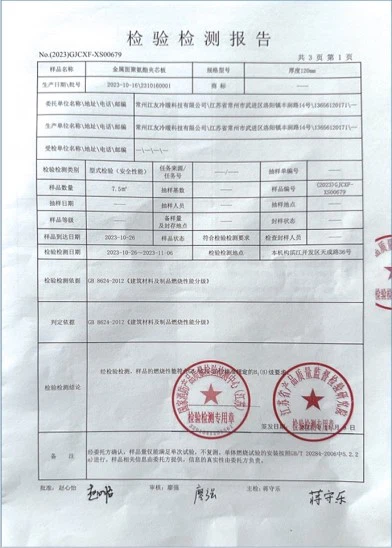
Certificate



Frequently Asked Questions
We're professional cold storage insulation board manufacturers and suppliers in China, specialized in providing high quality customized service. We warmly welcome you to buy discount cold storage insulation board made in China here from our factory.
shipping cold storage panels, fda compliant cold storage panels, sensor equipped cold storage panels